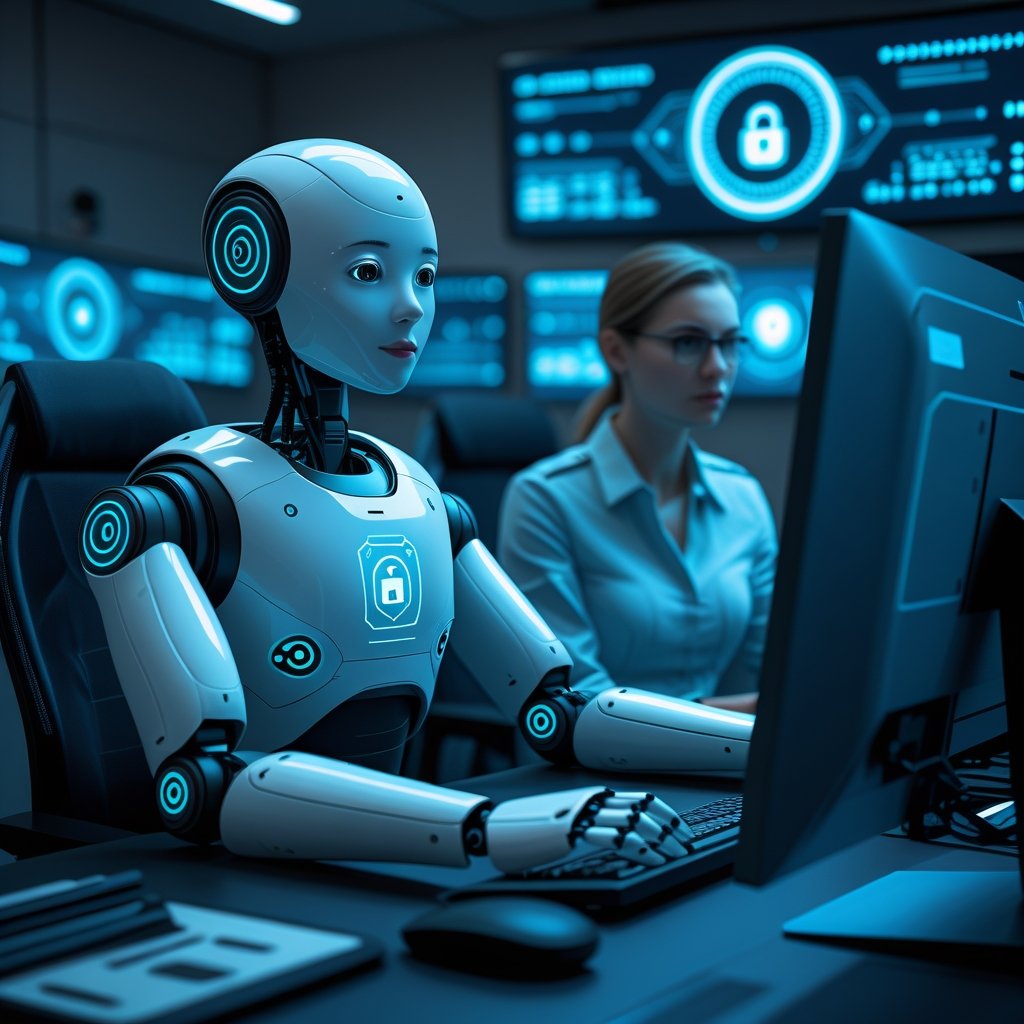
Something fundamental shifted in cybersecurity this year. We're not talking about incremental improvements to threat detection or slightly faster incident response times. We're witnessing the moment AI stops being a tool security analysts use and starts being a teammate they work alongside.
By the end of 2026, industry analysts predict that 30% or more of Security Operations Center (SOC) workflows will be executed by AI agents, not humans. That isn't a statistic about automation—it's a statement about transformation.
The End of the Co-Pilot Era
For the past few years, AI in cybersecurity has played the role of assistant. It flagged suspicious activity. It suggested correlations between events. It reduced noise so human analysts could focus on signal. Useful? Absolutely. Revolutionary? Not quite.
The limitation was always context. A co-pilot needs constant direction. It can suggest, but it can't decide. It can alert, but it can't act. Every judgment call required a human in the loop, which meant every bottleneck stayed a bottleneck.
That's changing now.
Enter the Agent Era
The new generation of security AI doesn't wait for instructions. It operates with defined parameters, evaluates situations against organizational policy, and executes responses without human micromanagement. It doesn't just detect a brute-force attack—it isolates the compromised endpoint, rotates credentials, and updates firewall rules in real time.
This isn't science fiction. Enterprises are deploying these systems today, and the results are measurable. Response times that previously took hours now happen in minutes. Anomalies that human analysts missed get caught consistently. The SOC is becoming a hybrid environment where human judgment handles strategic decisions while AI agents handle tactical execution.
The Double-Edged Algorithm
Of course, the same technology transforming defensive capabilities is also accelerating offensive ones. Cybercrime has entered what security researchers call an "industrial phase." AI-driven attacks scale faster, adapt quicker, and require less technical expertise to deploy than ever before.
Ransomware operators now use AI to identify high-value targets within compromised networks automatically. Phishing campaigns leverage language models to craft messages indistinguishable from legitimate communications. Attackers aren't just using AI as a tool—they're building autonomous systems that scout, penetrate, and exploit without human intervention.
The implications are stark: organizations that don't adopt AI-driven defense will soon be unable to keep pace with AI-driven offense. The asymmetry between attacker and defender is narrowing, but only for those willing to evolve.
What This Means for Security Teams
The transition from co-pilot to coworker doesn't eliminate the need for human expertise—it elevates it. When AI handles routine investigations and initial response, analysts can focus on threat hunting, strategic planning, and complex attribution work that machines still struggle with.
But this shift requires new skills. Tomorrow's security professionals need to understand not just how to read logs, but how to train models, validate AI decisions, and audit automated responses for bias and blind spots. The SOC of 2026 is less a room full of analysts staring at dashboards and more a command center where humans orchestrate an ensemble of intelligent agents.
The New Normal
We're past the point where AI in cybersecurity was optional or experimental. It's now infrastructural. The organizations that recognize this transition early—and redesign their operations around human-AI collaboration rather than human-AI assistance—will define the security landscape for the next decade.
The future SOC isn't human versus machine. It's human plus machine, operating at a scale and speed neither could achieve alone.
Welcome to the agent era.