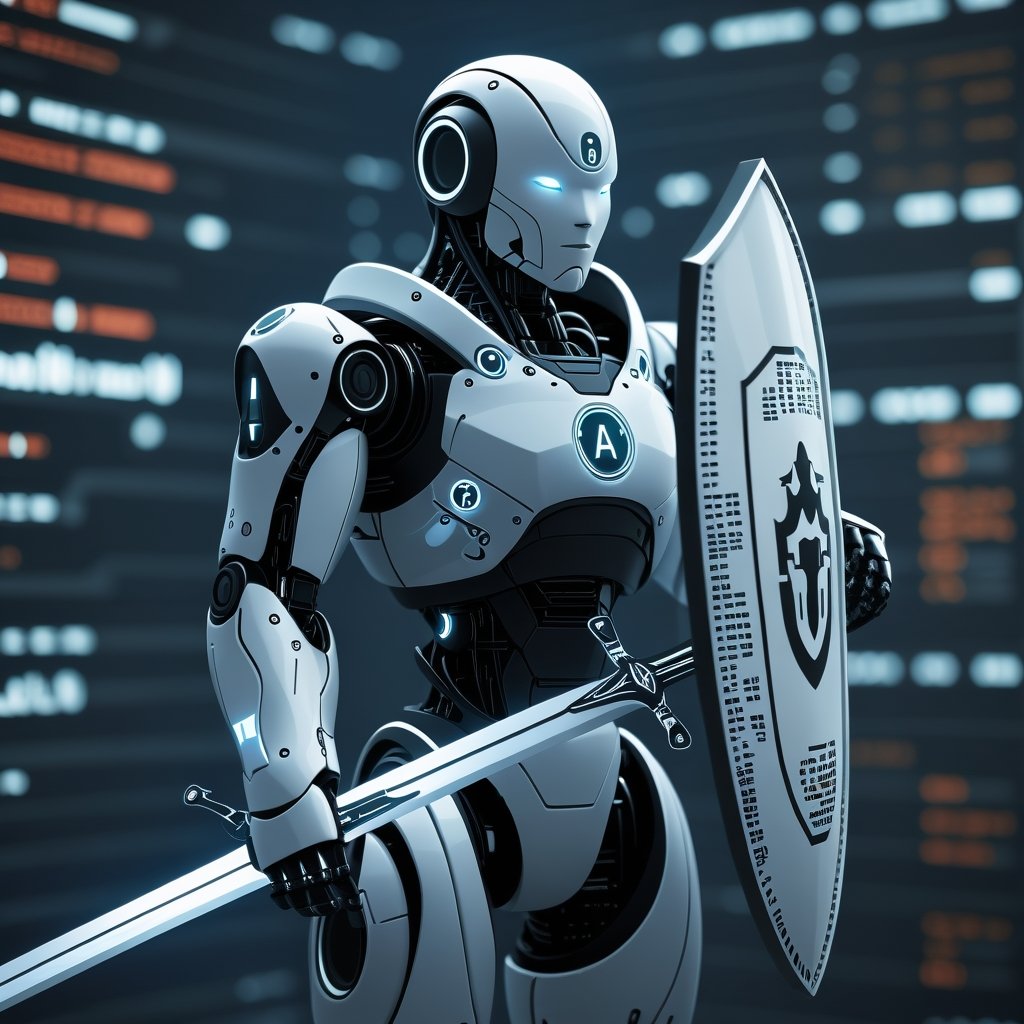
Cybersecurity has always been an adversarial discipline—attackers develop new techniques, defenders respond with countermeasures, attackers adapt, and the cycle continues. For decades, this back-and-forth happened at human speed. Analysts researched vulnerabilities. Security teams developed patches. Attackers studied defenses and crafted new exploits. The tempo of this conflict was fundamentally limited by human cognitive speed and availability.
AI agents are changing that equation entirely. These systems can operate continuously without fatigue, process vast quantities of data in seconds, identify patterns humans would miss, and execute complex multi-step operations autonomously. They're beginning to reshape cybersecurity in ways that extend far beyond simple automation of existing tasks.
The question isn't whether AI will transform cybersecurity—that transformation is already underway. The crucial question is whether AI capabilities will benefit defenders more than attackers, or whether we're entering an era where offensive AI advantages create unprecedented security challenges.
What Makes AI Agents Different
Before examining specific applications, it's important to understand what distinguishes AI agents from traditional automation and earlier machine learning approaches.
Autonomy and Decision-Making
Traditional security automation follows explicit rules. If condition X is met, take action Y. These systems are rigid, failing when encountering situations their creators didn't anticipate.
AI agents, particularly those leveraging large language models and reinforcement learning, can reason about novel situations. They interpret context, weigh trade-offs, and choose actions without requiring humans to have pre-programmed every possible scenario.
This autonomy enables AI agents to operate in the ambiguous, rapidly evolving environment of cybersecurity where clear rules rarely exist and novel situations arise constantly.
Learning and Adaptation
Machine learning has been used in cybersecurity for years, primarily for pattern recognition in threat detection. AI agents take this further by continuously learning from outcomes.
A defensive AI agent that blocks a suspicious email and later learns the email was legitimate can adjust its decision-making process. An offensive AI agent that fails to exploit a target can analyze why its approach failed and try different tactics.
This adaptive capability means AI agents improve over time, developing intuitions about what works and what doesn't in ways that static models cannot.
Multi-Step Planning and Execution
Perhaps most significantly, modern AI agents can break down complex objectives into subtasks, execute those tasks in sequence, handle errors, and adapt plans when circumstances change.
A security AI agent asked to investigate potential data exfiltration might autonomously: query log aggregation systems, identify anomalous patterns, trace network connections, analyze file access patterns, correlate with threat intelligence, and generate a comprehensive incident report—all without human intervention at each step.
Defensive Applications: AI as Ally
On the defensive side, AI agents are already demonstrating transformative capabilities across multiple security domains.
Threat Detection and Analysis
The volume of security telemetry generated by modern enterprises vastly exceeds human analytical capacity. Firewalls, intrusion detection systems, endpoint agents, cloud logs, and application monitoring generate millions of events daily.
AI agents excel at processing this deluge, identifying subtle patterns that indicate compromise. Traditional signature-based detection misses novel attacks. AI systems can recognize anomalous behaviors even when specific attack signatures are unknown.
For example, an AI agent might notice that a service account usually accesses databases during business hours from specific IP addresses. When that account suddenly connects at 3 AM from an unusual location and begins querying customer data it's never accessed before, the AI can flag this as potentially compromised—even though each individual action appears legitimate.
This behavioral analysis extends beyond simple rule violations to understanding normal patterns and detecting deviations that might indicate intrusion, insider threats, or compromised credentials.
Automated Incident Response
When threats are detected, speed of response is critical. Every minute an attacker maintains access increases potential damage. Human response times—identifying the threat, assessing severity, determining appropriate actions, implementing containment—can stretch to hours or days.
AI agents can respond in seconds. Upon detecting ransomware encryption activity, an AI response system might autonomously isolate affected systems, terminate suspicious processes, block network communications, snapshot system states for forensics, and alert human security teams—all before a human analyst even opens the alert.
This doesn't mean eliminating human oversight. Rather, AI agents handle immediate containment while humans make strategic decisions about remediation and recovery. The partnership amplifies effectiveness beyond what either could achieve alone.
Vulnerability Assessment and Penetration Testing
Finding security weaknesses before attackers do is fundamental to defensive security. Traditional penetration testing involves human experts attempting to compromise systems using known techniques.
AI agents can automate and scale this process. Autonomous pentesting systems can scan for vulnerabilities, develop exploitation chains, test defenses, and generate detailed reports identifying weaknesses—operating continuously rather than during periodic assessments.
These systems go beyond simple vulnerability scanning by actually attempting exploitation, chaining multiple vulnerabilities together, and adapting to defensive responses. They provide more realistic assessments of actual security posture rather than theoretical vulnerability lists.
Security Operations Center (SOC) Augmentation
Security Operations Centers process vast numbers of alerts, most of which turn out to be false positives or low-severity events. Analyst burnout from alert fatigue is a persistent challenge.
AI agents can triage alerts, investigating low and medium severity events autonomously, escalating only those requiring human expertise. This allows human analysts to focus on the most critical threats while AI handles routine investigations.
An AI SOC agent might gather additional context about an alert—checking if the affected user recently contacted IT, whether similar activity occurred elsewhere, what the affected system's risk profile is—and make preliminary determinations about whether escalation is warranted.
Offensive Applications: AI as Adversary
The same capabilities that make AI agents powerful defenders translate directly to offensive applications.
Automated Reconnaissance and Target Selection
Attackers spend significant time and effort researching potential targets—identifying valuable systems, understanding network topologies, discovering exposed services, and assessing defensive capabilities.
AI agents can automate this reconnaissance, continuously scanning for targets, analyzing their attractiveness based on vulnerability exposure and data value, and maintaining databases of potential attack paths.
Nation-state actors and sophisticated criminal organizations are likely already deploying such systems, conducting persistent reconnaissance against thousands of organizations simultaneously to identify the most opportune targets.
Adaptive Exploitation
Traditional exploits are static—they either work or they don't. When defenses block an exploit, attackers must manually develop alternatives.
AI agents can iteratively attempt exploitation, analyze defensive responses, and modify their approach. If an initial SQL injection attempt is blocked, the AI might try encoding variations, using different syntax, or switching to alternative exploitation methods—all autonomously within seconds.
This creates a fundamentally different defensive challenge. Rather than blocking specific exploits, defenses must be robust against entire classes of attacks and adaptive adversaries that will probe for any weakness.
Social Engineering at Scale
Phishing and social engineering remain highly effective attack vectors. AI agents, particularly those leveraging large language models, can craft highly personalized phishing content at massive scale.
An AI agent might analyze public social media profiles, corporate websites, and other information sources to generate targeted phishing emails that reference specific projects, colleagues, or interests—making them far more convincing than generic phishing campaigns.
Voice cloning and deepfake technologies enable AI agents to conduct vishing (voice phishing) attacks with synthetic audio indistinguishable from genuine colleagues or authority figures.
Autonomous Attack Chains
Perhaps most concerning, AI agents can plan and execute complete attack sequences—initial compromise, privilege escalation, lateral movement, data exfiltration—without human operators making tactical decisions.
An autonomous attack agent might identify a vulnerable web application, exploit it to gain initial access, deploy reconnaissance tools to map the internal network, identify high-value systems, compromise credentials through password spraying or exploit, establish persistence mechanisms, locate and exfiltrate sensitive data, and cover its tracks—operating continuously and adapting to defensive responses encountered along the way.
This capability doesn't just increase attack speed. It changes the attacker-to-target ratio. Where human-operated attacks might target dozens of organizations simultaneously, autonomous AI attacks could target thousands.
The Asymmetry Problem
One of the most concerning aspects of AI in cybersecurity is the potential asymmetry between offensive and defensive applications.
Offensive Advantages
Attackers need only find one successful path. Defenders must protect against all possible attacks. This fundamental asymmetry existed before AI but may be amplified by autonomous agents.
An offensive AI agent can try thousands of variations, probe for any weakness, and succeed if even one approach works. Defensive AI must maintain comprehensive protection across all attack surfaces.
Attackers face fewer operational constraints. They don't need to worry about false positives disrupting business operations, explaining decisions to stakeholders, or operating within legal and ethical boundaries. This freedom allows aggressive exploration of attack possibilities.
The cost of scaling offensive operations may be lower than defensive operations. Once developed, an offensive AI agent can be deployed against unlimited targets with minimal additional cost. Defensive AI requires per-organization deployment and tuning.
Defensive Advantages
Defenders have home-field advantage with access to their own telemetry, network topology, and systems. This visibility enables AI defenders to recognize normal patterns and detect anomalies that external attackers might miss.
Regulatory and legal frameworks constrain attackers while supporting defenders. Using AI for defensive purposes is legal and encouraged. Deploying offensive AI agents against targets without authorization is criminal in most jurisdictions, limiting who can openly develop and deploy such systems.
Defenders can share threat intelligence, pooling knowledge about attack patterns, techniques, and indicators of compromise. This collective defense amplifies individual organizational capabilities.
The crucial question is whether these defensive advantages offset offensive ones, or whether the fundamental asymmetry favors attackers in the AI era.
Ethical and Legal Considerations
The deployment of autonomous AI agents in cybersecurity raises significant ethical and legal questions.
Autonomous Decision-Making and Accountability
When AI agents make security decisions autonomously—blocking traffic, isolating systems, responding to threats—who bears responsibility for mistakes?
If a defensive AI agent incorrectly identifies legitimate business activity as an attack and shuts down critical systems, causing substantial financial harm, what liability framework applies? Are these simply technical failures, or should there be specific legal standards for autonomous security systems?
On the offensive side, if an AI agent autonomously conducts attacks beyond its operator's explicit authorization, does that reduce criminal liability? Most legal systems reject such arguments in other domains, but AI autonomy in cybersecurity creates novel situations.
Arms Race Dynamics
AI-powered cybersecurity creates dynamics similar to other technological arms races. Each advancement in offensive capabilities drives defensive investment, which in turn motivates new offensive developments.
This pattern risks runaway escalation where increasingly capable AI agents operate with decreasing human oversight, potentially creating situations where AI systems make consequential security decisions faster than humans can intervene.
International norms and treaties governing autonomous weapon systems in warfare might provide frameworks for thinking about autonomous cyber capabilities, but meaningful international agreement on cyber AI governance remains elusive.
Dual-Use Dilemma
Many AI capabilities useful for defensive security are equally applicable to attacks. Vulnerability discovery, exploit development, and security testing tools can serve both red teams and malicious actors.
This creates challenges for responsible AI research and development. Publishing advances in autonomous pentesting helps defenders assess their security, but also provides blueprints for attackers. Not publishing such research leaves defenders less informed but doesn't truly prevent attackers from developing similar capabilities.
Preparing for the AI-Powered Threat Landscape
Organizations must adapt security strategies to address AI-powered threats while leveraging AI defensive capabilities.
Defensive AI Adoption
Organizations should be deploying or planning to deploy AI-powered security tools across multiple domains:
Threat Detection: AI-powered endpoint detection and response (EDR), network monitoring, and SIEM (Security Information and Event Management) systems that can recognize anomalous behaviors.
Security Automation: AI agents that handle routine security tasks—log analysis, alert triage, preliminary incident investigation—freeing human analysts for complex work.
Predictive Security: Systems that anticipate likely attack vectors based on environmental factors, emerging threat intelligence, and organizational risk profiles.
Human-AI Partnership Models
Effective security in the AI era won't be purely automated. It will involve partnership between human expertise and AI capabilities.
Humans provide strategic thinking, ethical judgment, contextual understanding, and creative problem-solving. AI provides speed, scale, pattern recognition, and tireless vigilance. Security operations should be designed to leverage both.
This might mean AI agents handling routine decisions autonomously while escalating novel or high-stakes situations to humans. It might mean humans providing high-level objectives while AI determines tactical implementations. Finding the right balance depends on specific contexts and risk tolerances.
Red Team AI Capabilities
Organizations should develop or acquire offensive AI capabilities for red teaming—testing defenses against AI-powered attacks before real adversaries launch them.
This isn't about developing weapons, but about understanding what AI-powered attacks look like, how effective current defenses are against them, and what improvements are necessary.
Adversarial AI Defenses
As AI agents become offensive tools, defenses specifically targeting AI behaviors become necessary. This might include:
Honeypots and Deception: Systems designed to waste AI attacker resources, gathering intelligence about their tactics while protecting real assets.
Behavioral Analysis: Detecting patterns characteristic of AI-driven attacks—unusual speed, systematic probing, specific error patterns—that differ from human attacker behaviors.
AI Model Poisoning Defenses: Protecting training data and models from manipulation attempts that could compromise AI defensive systems.
The Road Ahead
Several trends will shape how AI continues transforming cybersecurity.
Model Capabilities Continue Advancing
Large language models grow more capable with each generation. Multimodal models that process text, images, audio, and code together enable richer understanding and more sophisticated operations.
As these underlying AI capabilities improve, both defensive and offensive cybersecurity AI will advance in lockstep. The arms race will intensify.
Commoditization of AI Security Tools
Just as automated vulnerability scanners and exploit frameworks became widely available, AI security tools will commoditize. Offensive and defensive AI capabilities currently available only to well-funded organizations or nation-states will become accessible to smaller actors.
This democratization means more actors can leverage AI for security purposes—both beneficial (small organizations defending themselves) and harmful (low-sophistication attackers becoming more effective).
Regulatory Frameworks Emerge
Governments will inevitably develop regulations around AI in cybersecurity. These might include:
- Requirements for human oversight of autonomous security decisions
- Liability frameworks for AI system failures
- Standards for AI security tool development and testing
- Export controls on certain offensive AI capabilities
- Disclosure requirements when AI is used in security contexts
How these regulations balance innovation against safety will significantly impact the trajectory of AI security development.
Integration with Broader AI Safety
Cybersecurity AI intersects with broader AI safety research. Questions about AI alignment, interpretability, robustness, and controllability apply equally to security contexts.
A defensive AI agent that develops aggressive responses exceeding its authorization resembles alignment problems in other domains. Offensive AI systems that might be used irresponsibly or cause unintended harm raise safety concerns similar to other autonomous systems.
Cybersecurity practitioners and AI safety researchers should collaborate to address these shared challenges.
Conclusion
AI agents represent both the most promising advance in cybersecurity defense and the most concerning evolution in offensive capabilities. The technology is fundamentally dual-use—the same advances that improve threat detection also enhance attack automation.
The outcome of this technological shift depends largely on choices made in coming years. Will defensive AI capabilities develop faster than offensive ones? Will meaningful guardrails and oversight mechanisms govern how AI is deployed in cybersecurity? Will international cooperation prevent runaway AI-powered cyber conflicts?
No single answer applies universally. Different organizations, countries, and contexts will see varying outcomes based on their investments, priorities, and circumstances.
What's certain is that cybersecurity is entering an era where AI agents are not just tools but active participants in the ongoing contest between attackers and defenders. Understanding these systems' capabilities and limitations, developing appropriate oversight and governance, and thoughtfully deploying AI in security contexts will determine whether this technological revolution strengthens or undermines our digital security foundations.
The rise of AI agents in cybersecurity is neither purely friend nor foe—it's a transformative force that will advantage those who most effectively harness its potential while managing its risks.